

A Guide to Downtown Buenos Aires – Monserrat and San Nicolas Neighbourhoods

Downtown is a must visit area of any trip to Buenos Aires, even though it’s not actually an official barrio of the city. Mostly referred to as “El Centro” or “Microcentro”, the capital’s downtown area is made up of three neighbourhoods: Monserrat, San Nicolas and Retiro. Our guide will mainly focus on all the places to visit within Monserrat and San Nicolas, just because these two neighbourhoods house the majority of the downtown’s tourist attractions.
Exploring these two barrios will easily keep you busy for an entire day, so you don’t have to worry about running out of things to do. In fact, as with most barrios in Buenos Aires, we could’ve easily spent two days around the downtown for a more leisurely visit.
If you’d like to see what we got up to in the Argentine capital, then watch our dedicated Buenos Aires video, which we shared on our YouTube channel Kitti and Jon. For more videos from the country, check out our Argentina playlist.
Disclosure: This post may contain affiliate links, which means we may receive a small commission if you click a link and purchase something. Clicking these links won’t cost you anything, but it will help us to keep this site up and running! Learn more about our affiliate policy.
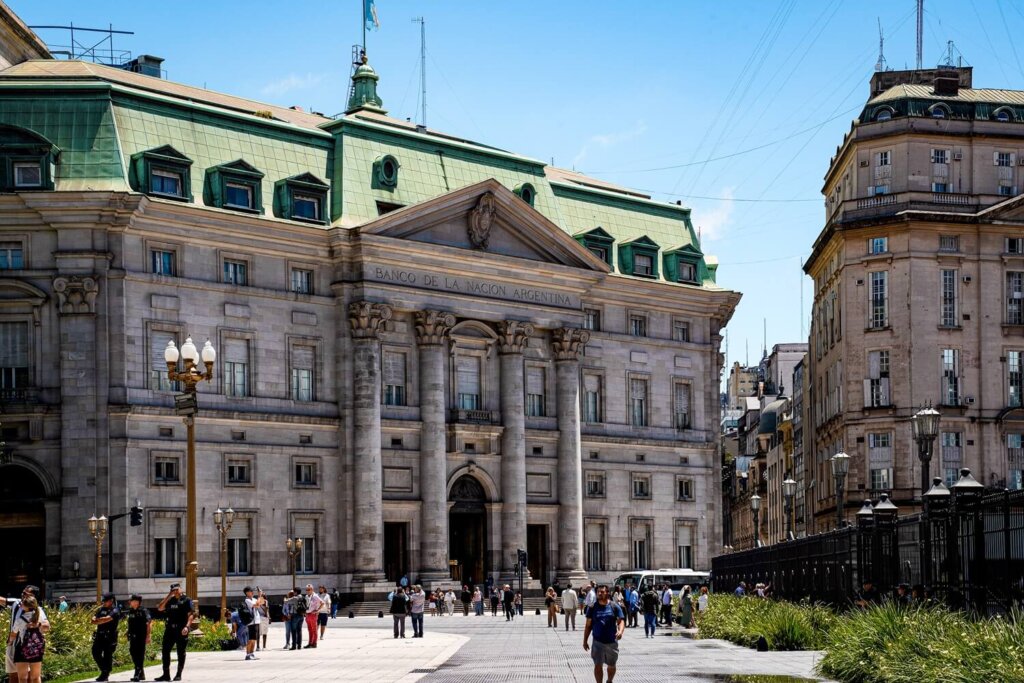
About Barrios Monserrat and San Nicolas in Buenos Aires
These two barrios are bordered by Puerto Madero to the east, San Telmo and Constitucion to the south, Balvanera to the west, and Retiro and Recoleta to the north.
Monserrat and San Nicolas are two of the oldest neighbourhoods in Buenos Aires. Monserrat’s origins can be traced back to 1580, and San Nicolas’ to 1733. Monserrat got its name from the Parish of Our Lady of Monserrat, which was built in 1769, and San Nicolas came from the San Nicolas Parish.
Both barrios are home to many important government buildings, plenty of historical sites, religious buildings, fantastic architecture and, of course, many eateries.
Our Top Travel Resources for Visiting Downtown Buenos Aires
- 🏨 Find your accommodations on Booking.com
- 🎫 Book an organised tour with GetYourGuide or Viator
- 🛜 Stay connected with Holafly eSIM. (5% off with code ‘KITTIAROUNDTHEWORLD’)
- ⚕️ Don’t forget to buy travel insurance via SafetyWing
- 🚌 How to get around Buenos Aires
Best Things to Do in Monserrat and San Nicolas in Buenos Aires
Plaza de Mayo
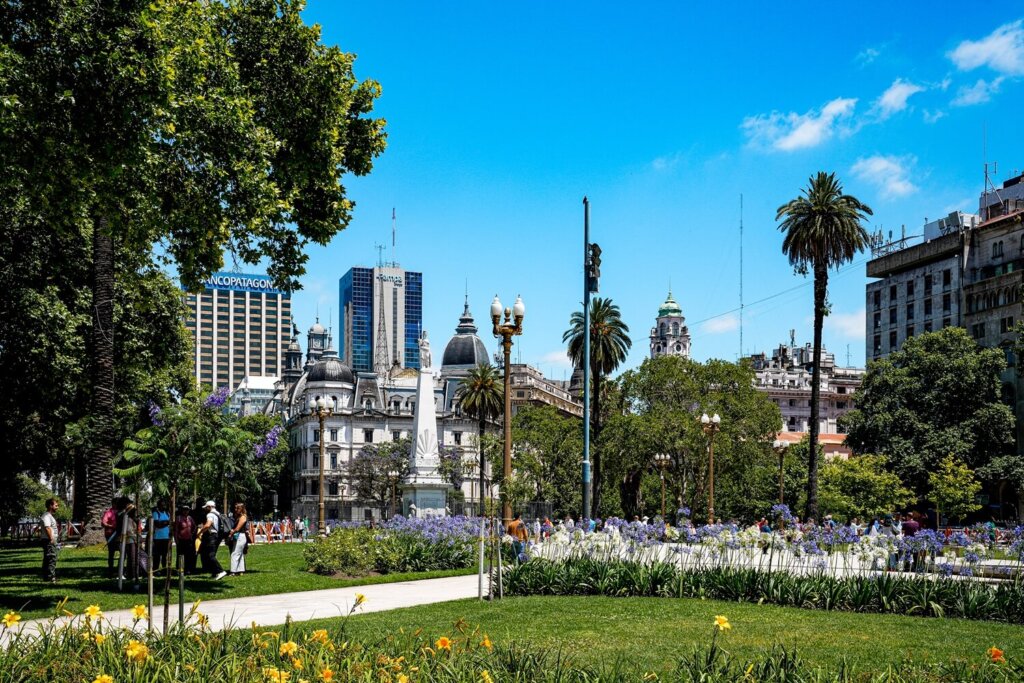
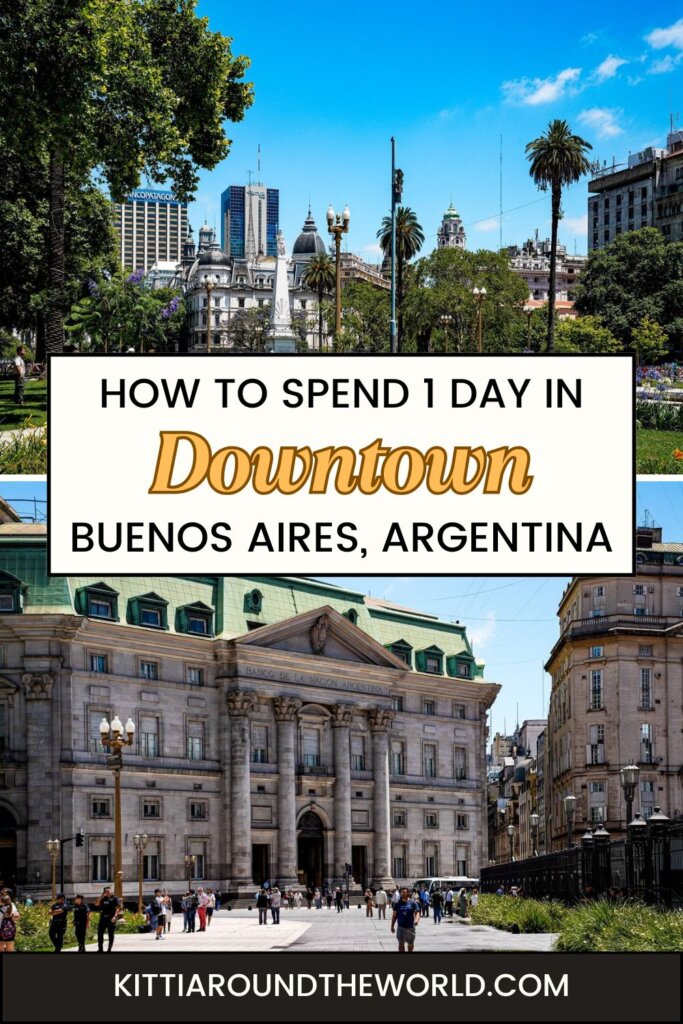
We began our Downtown Buenos Aires tour in Plaza de Mayo, the capital’s main square. It was a great spot to start because the plaza was surrounded by many iconic historical buildings, so we could see a lot in a short space of time.
The square is the political centre of Buenos Aires and, as you can imagine, it has witnessed many major historical events over the years. For example, Argentina declared its independence from Spain here in 1816. Today, Plaza de Mayo is still where many demonstrations and protests take place.
In November the square looked beautiful with its blooming trees, although it was probably the busiest tourist spot we’d been to so far, apart from the Japanese Garden in Palermo and the Ateneo Grand Splendid Bookstore in Recoleta.
The only thing we missed from the square were some benches where we could’ve just sat and watched the world go by, like we’d done at many other main squares across Latin America.
Top Tip. Every day – apparently every two hours – you can witness the Changing of the Guard at Plaza de Mayo. The grenadiers march from Casa Rosada to the Metropolitan Cathedral, where they guard the mausoleum of General Don José de San Martín.

Casa Rosada
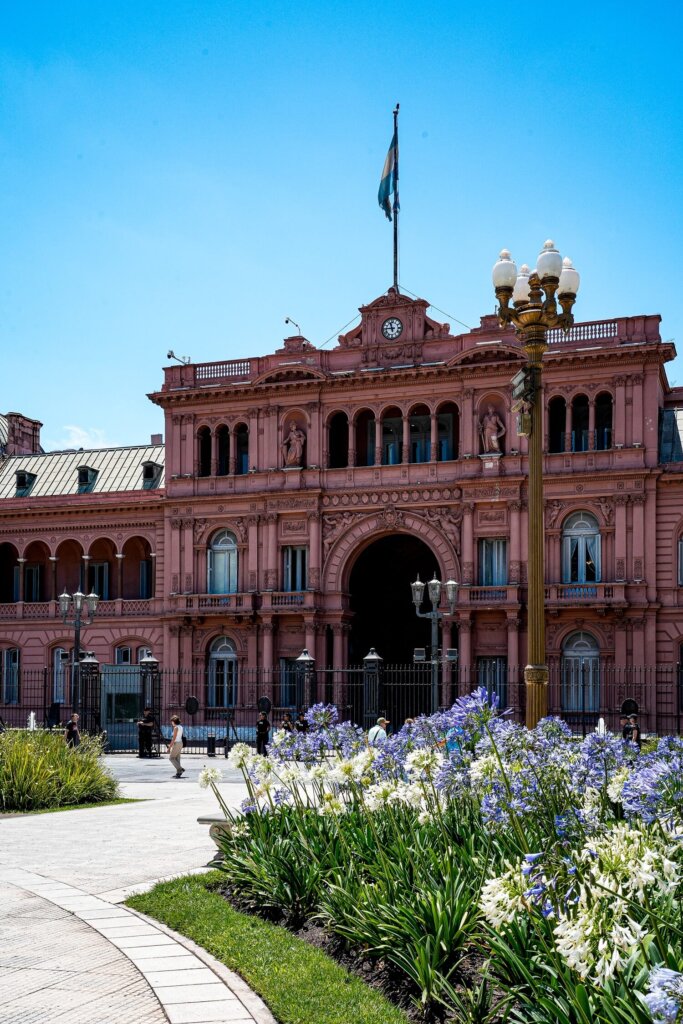
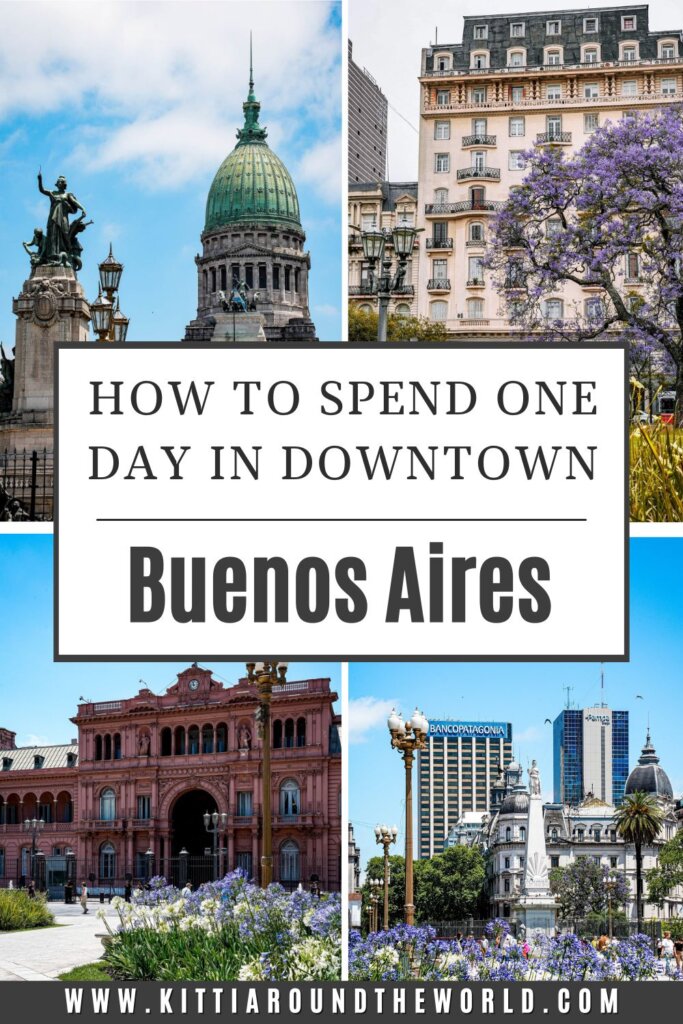
Translating to “Pink House”, Casa Rosada is one of the most iconic buildings in Buenos Aries. Occupying the eastern side of Plaza de Mayo, it is the seat of the Argentine national government and where the president’s office is.
Today’s building stands on the site of a fort that was built by the Spanish in 1580. However, after independence it was converted into a customs house before President Bartolomé Mitre chose the building to be the seat of his government.
The building has been re-modelled and enlarged several times over the decades. Now, you may be wondering about the unique pink colour of the building. We found two different explanations online. One said that with pink being a mix of red and white, it represented the opposing political parties; the Federals used red, while the Unitarians used white. The other explanation says that in order to avoid the paint peeling in the humidity, the building was painted with cows’ blood. (I think we personally prefer the first explanation for the pink colour!).
It’s a pretty impressive building from the outside. Unfortunately, they only offer guided tours for school groups, so we couldn’t see its interior. However, there is a museum (Museo Casa Rosada) that you can visit. The Museum is open from Wednesday to Sunday between 11AM and 6PM. It’s free to enter. More up-to-date information can be found on the museum’s official website.
If you want to learn more about Argentina’s political history, we recommend taking this dedicated Buenos Aires Political Tour.
Buenos Aires Metropolitan Cathedral
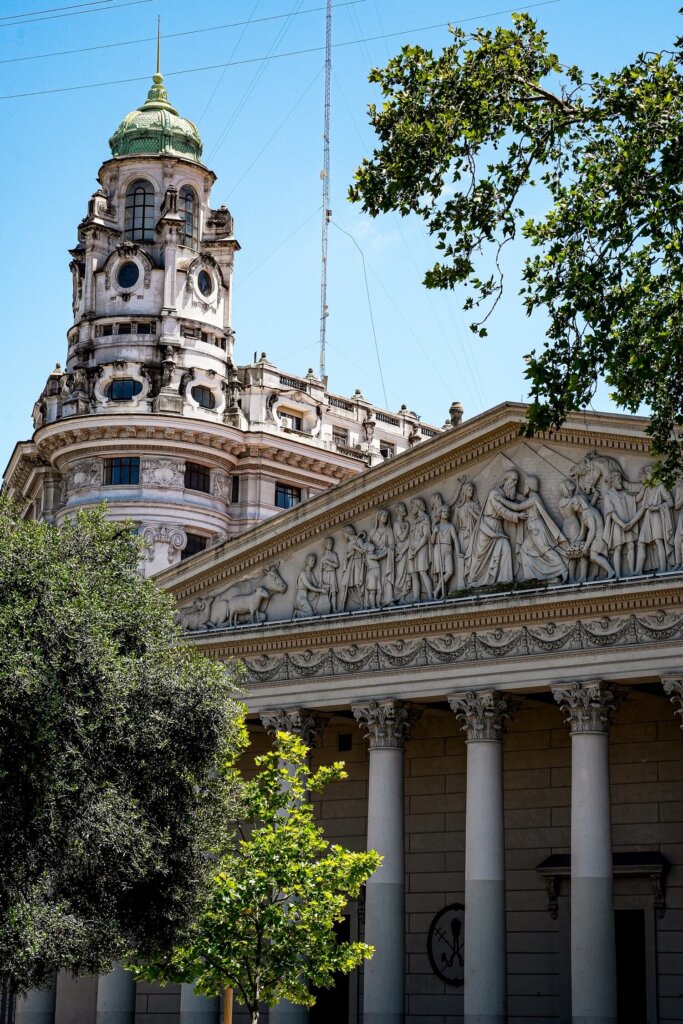
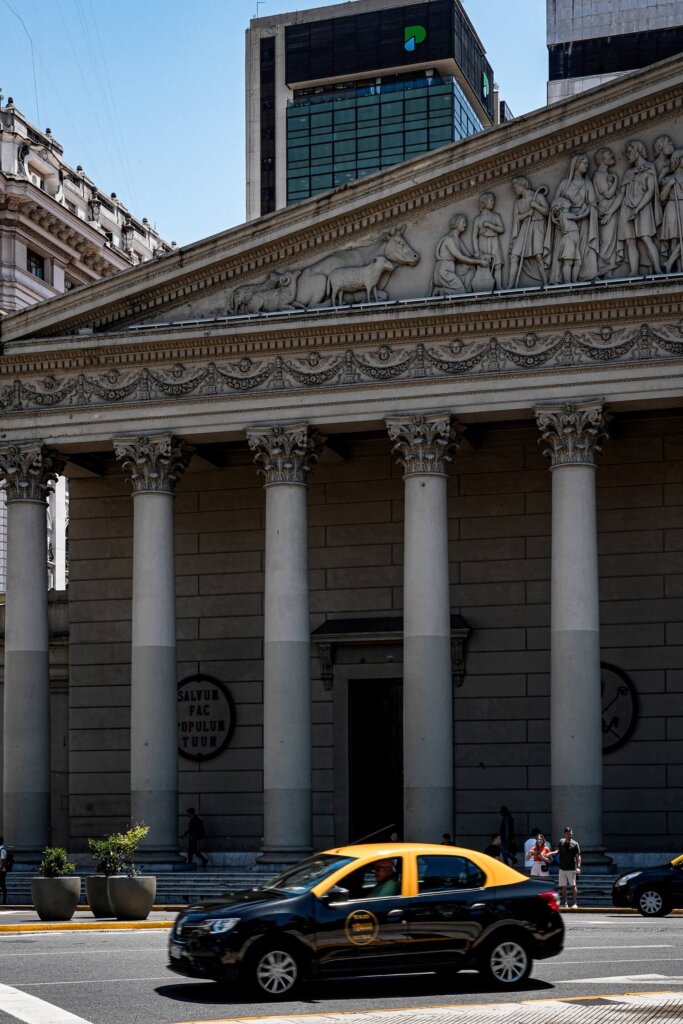
Another important landmark on the northern side of Plaza de Mayo is the Metropolitan Cathedral. At first we didn’t even realise that it was a Catholic church and nearly mistook it for a fancy bank building. It looked more like the temples we’d seen in Greece, with Neo-Classical columns and a triangular frontispiece. However, as we later learnt, the columns represent the twelve apostles and the frontispiece portrays the encounter between Jacob and Joseph in Egypt.
The first chapel was erected here by the city’s founder Juan de Garay in 1593. Of course, the building has undergone several changes since then, until it became the cathedral you see today. The interior of the Cathedral is also very beautiful. It houses the mausoleum of General José de San Martín, “the Liberator of Argentina, Chile and Peru”. In addition, Pope Francis used to perform mass here until 2013 as Archbishop Jorge Bergoglio, until he assumed his office in the Vatican. In honour of him, there is now a museum (Pope Francis Museum), which exhibits many of his personal and liturgical objects.
Museum Cabildo of Buenos Aires
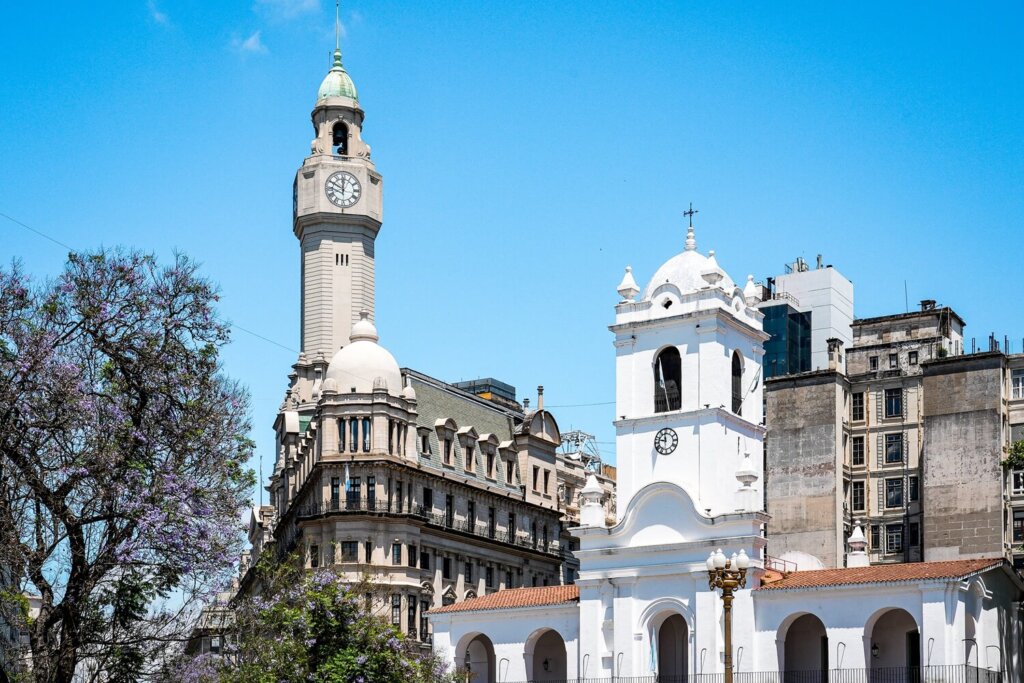
The white building that at first glance looks more like a church (at least in our opinion), is the Cabildo Museum. Its official full name is a mouthful: Museo Nacional del Cabildo de Buenos Aires y de la Revolución de Mayo, or in English, National Historical Museum of the Cabildo and the May Revolution. So, let’s just stick with Cabildo!
The museum is located on the west side of Plaza de Mayo, opposite Casa Rosada. During the Spanish colonial era the building was the seat of the towns council. However, it has also been used by other institutions such as the Royal Audience of Buenos Aires, the Public Library of Buenos Aires and even the prison. Cabildo was also where they took the first steps toward independence (May Revolution of 1810). It’s been a National Historic Monument since 1933 and a public museum since 1938.
Cabildo is open from Wednesday to Sunday between 10:30AM and 6PM. It’s also free to visit. More up-to-date information can be found on the museum’s official website.
Barrio Puerto Madero
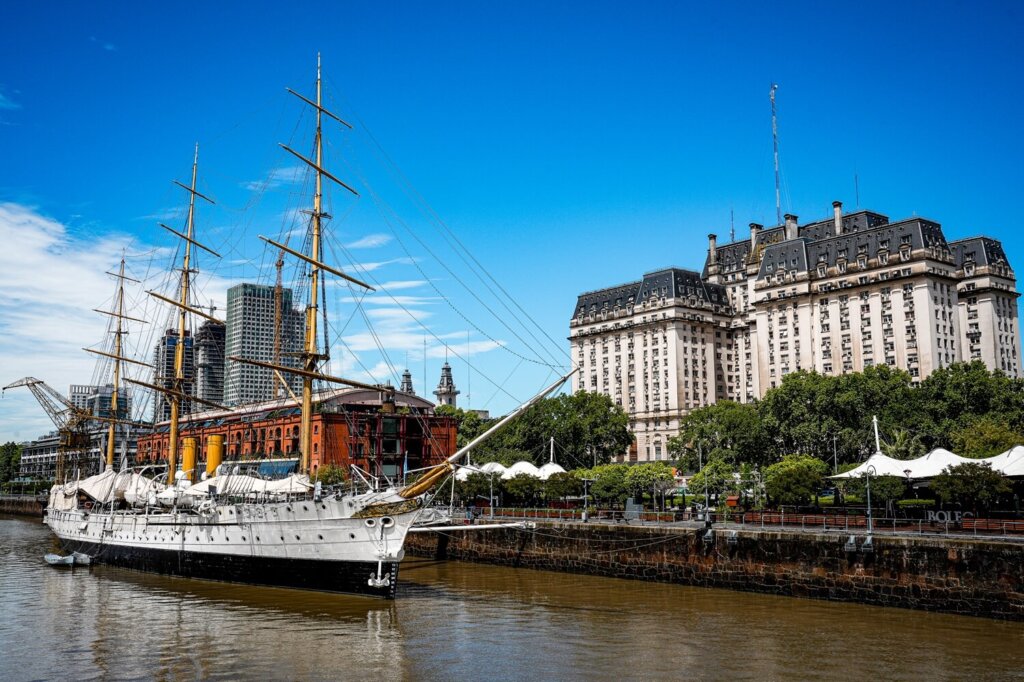
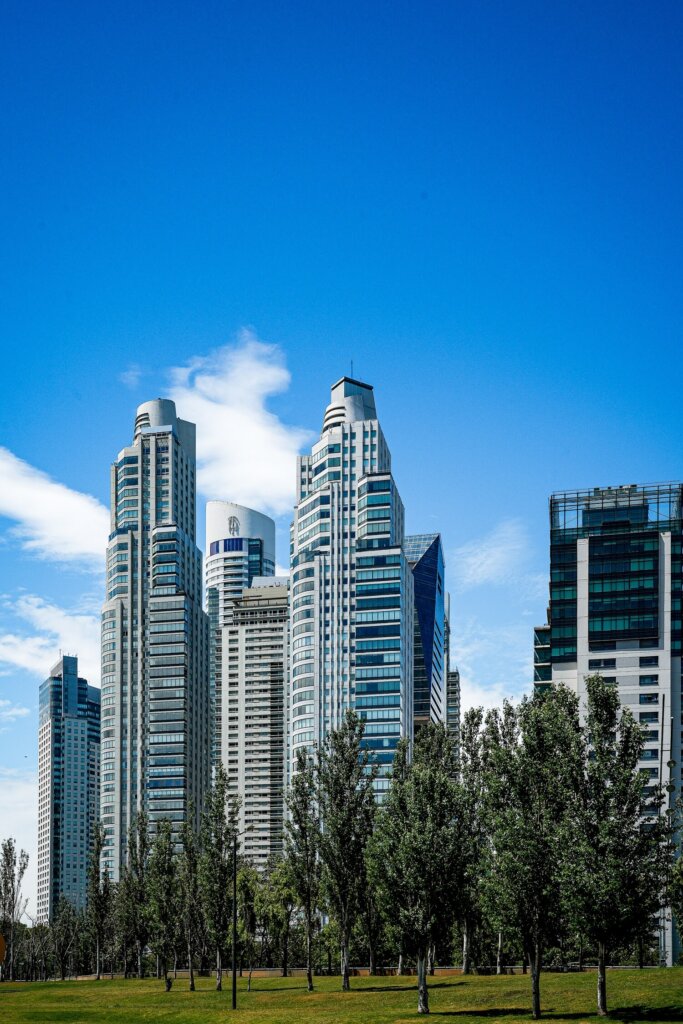
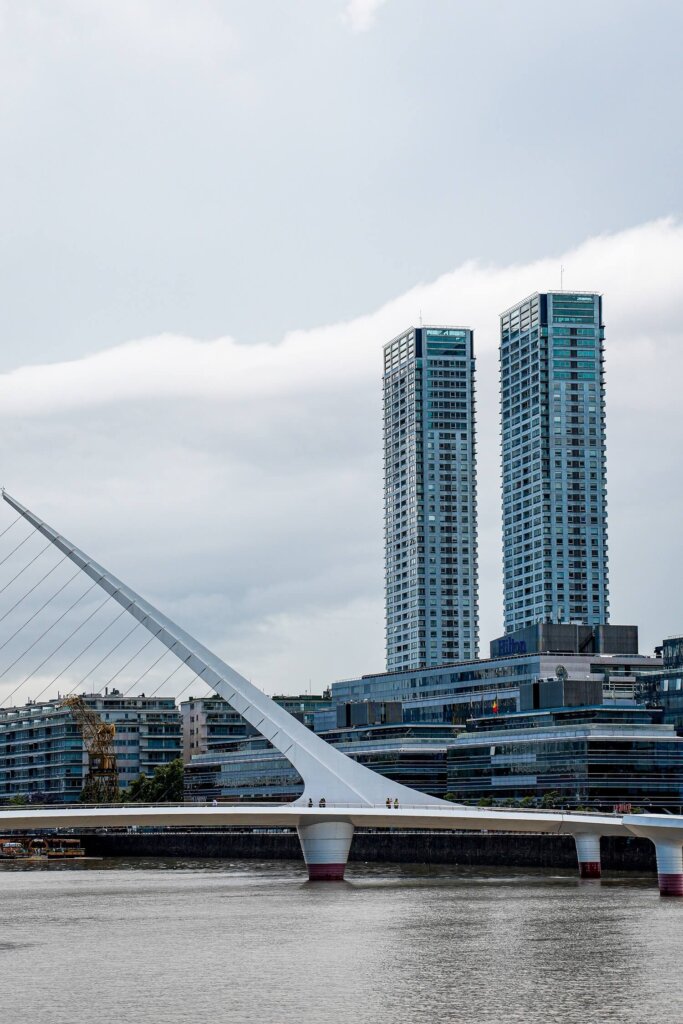
Monserrat is bordered to the east by the Puerto Madero neighbourhood. It’s the trendy port area of Buenos Aires, with few attractions but plenty of cafes and restaurants. Since it’s just across from Casa Rosada, we decided to check this area out.
The area was quieter than Plaza de Mayo during the day, although we suspect that it comes to life in the evening when people come out for drinks and food. The dock area reminded us of the docks of Liverpool in England. Along Rio Dique there were two ship museums: A.R.A. Uruguay Museum Ship and A.R.A. Sarmiento Frigate. As we later learnt on our Antarctica expedition, the former was the ship that in 1903 came to the rescue of a Swedish vessel, the Antarctic, which had been shipwrecked in extreme weather.
In between the two ship museums is Puente de la Mujer, or Women’s Bridge. It’s a rotating footbridge designed by Spanish architect Santiago Calatrava. The bridge symbolises a couple dancing the tango. Crossing the bridge led us to Parque Mujeres Argentinas and the Reserva Ecológica Costanera Sur behind that. They are two of the best parks to visit in Buenos Aires, with the Costanera Sur Ecological Reserve being one of the largest urban reserves in Latin America.
We only had time for a brief visit. However, if you want to get to know this neighbourhood a bit more, we suggest going with this FREE Puerto Madero walking tour.
Café Tortoni
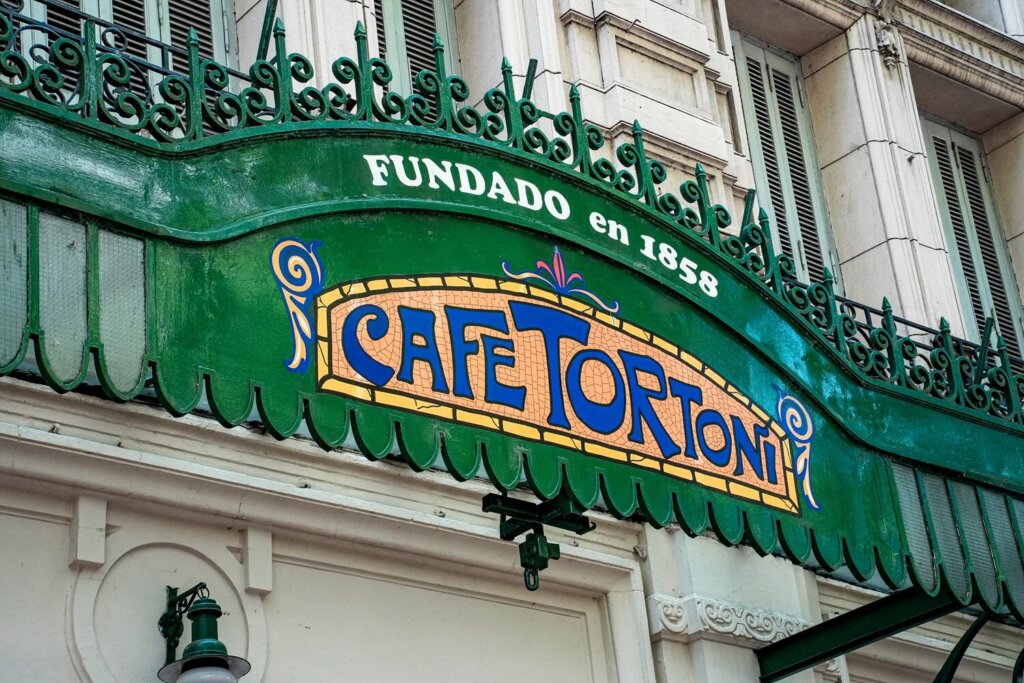
Founded in the 19th century, Cafe Tortoni is the oldest cafe in Buenos Aires. From the outside it doesn’t actually look like much. You would only know that this is a popular spot because of the queue in front of it. Based on the photos we’d seen online, the interior of Cafe Tortoni looks like you’ve stepped back in time. There are marble tables, stained glass windows, paintings, and there are often tango and jazz shows in the basement. It used to be a gathering place for writers, musicians, intellectuals and popular public figures. The tables inside have plaques on them with the names of the people who used to sit there.
We really wanted to have a coffee and alfajores here, but by the time we got to the cafe we were both too hungry to queue. So, we decided to give it a miss and grabbed some empanadas around Plaza del Congreso instead, our next stop in the Monserrat neighbourhood of Buenos Aires.
Cross the Avenida 9 de Julio
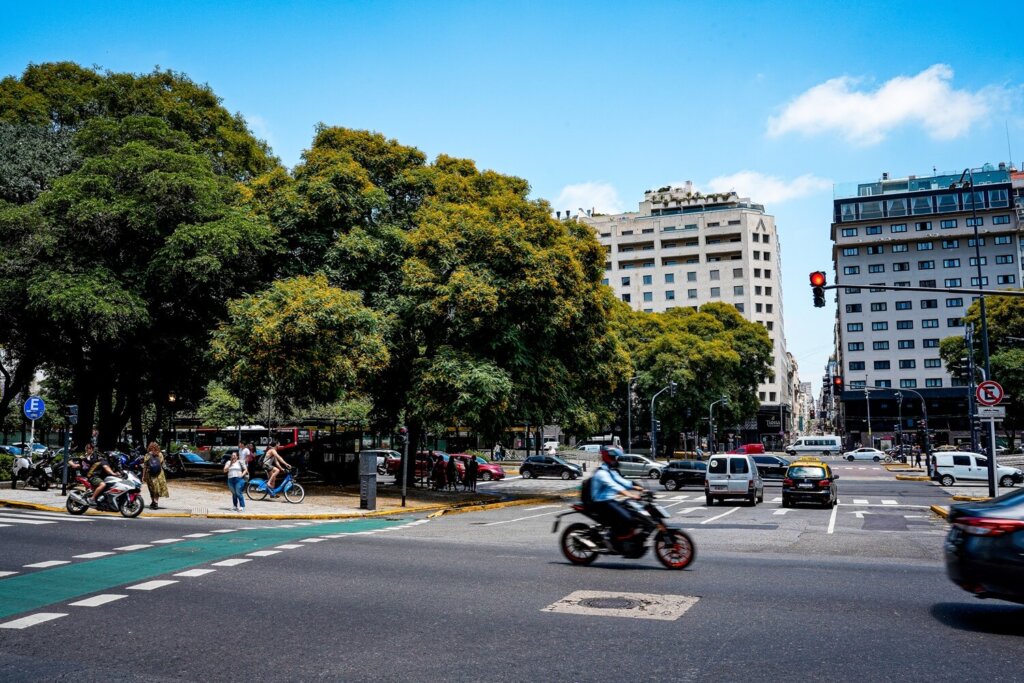
Okay, we wouldn’t usually consider a main road a “must see attraction”, but Avenida 9 de Julio is different. With a width of 140 m and 14 lanes of traffic, it is indeed one of the world’s widest streets. So, we think it deserves a separate section in our downtown Buenos Aires guide. Plus, if you’re following Avenida de Mayo towards Plaza del Congreso, then you’ll cross the street anyway.
Avenida 9 de Julio, or 9th July Avenue, runs for about 3 km between Barrio Retiro to the north and Barrio Constitucion to the south. The name of the avenue commemorates Argentina’s independence day.
There are many landmarks along its stretch, including the iconic El Obelisco. As you can imagine, many important celebrations take place on the avenue, such as when Argentina won the FIFA World Cup in 2022.
Palacio Barolo
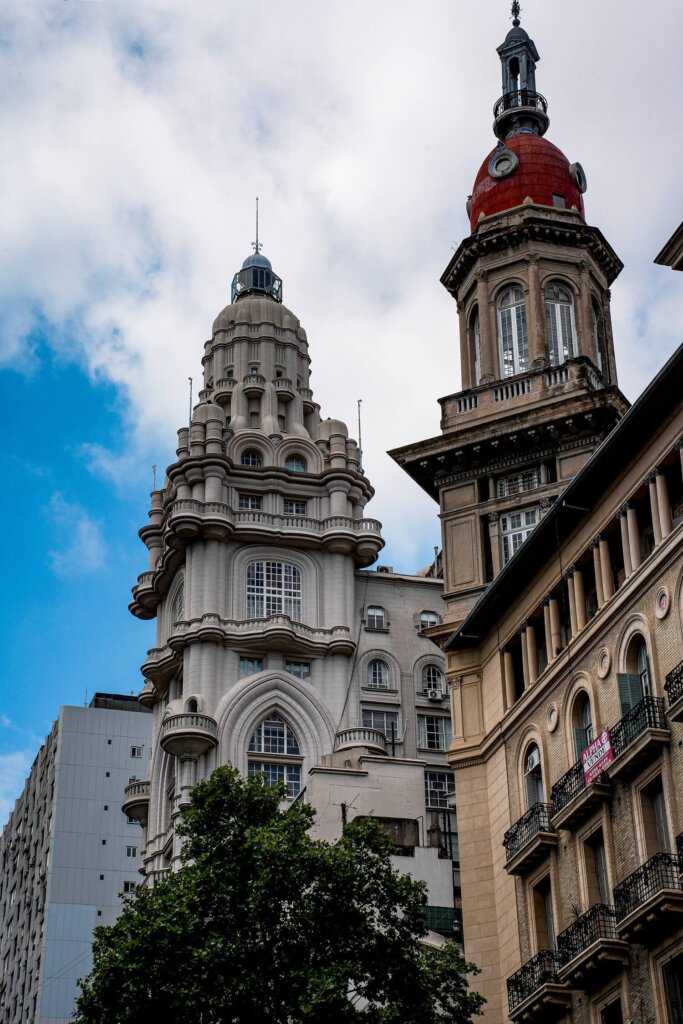
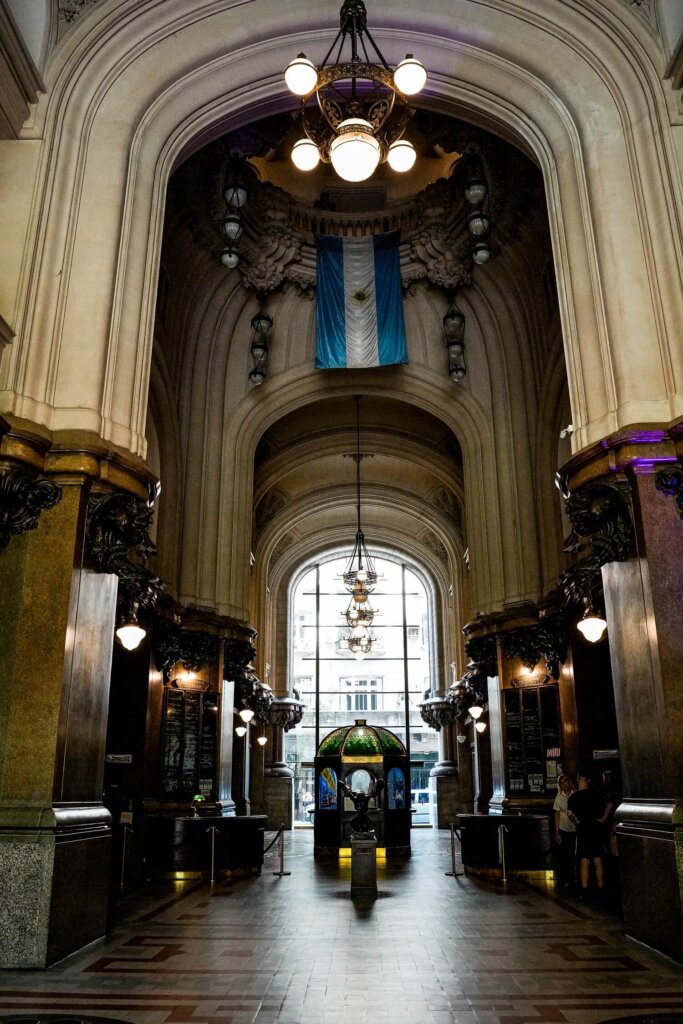
After crossing Avenida 9 de Julio carry on along Avenida de Mayo towards Plaza del Congreso. Just before reaching the square we passed another iconic building in Monserrat: Palacio Barolo.
The building was designed by Italian architect Mario Palanti for the also Italian businessman Luis Barolo. Palacio Barolo looked similar to Palacio Salvo, one of the most iconic buildings in Montevideo, Uruguay’s capital. This is because, as it turns out, Palanti designed both buildings.
Barolo, who commissioned Palanti, admired Dante Alighieri’s work, so he wanted the building to be in accordance with the poet’s “Divine Comedy”. Palacio Barolo has 22 floors and 2 basements, divided into three sections: heaven, hell and purgatory. Until 1935, it was the tallest building in South America.
Although today Palacio Barolo is mainly used as an office building, you can actually take a guided tour inside. Most people take the tour because of the 360-degree viewing balconies that give you some great panoramic views of Buenos Aires. The tours run multiple times every day of the week apart from Tuesday. It’s quite a pricey tour though, at 45,000ARS per person.
Congreso de la Nación Argentina
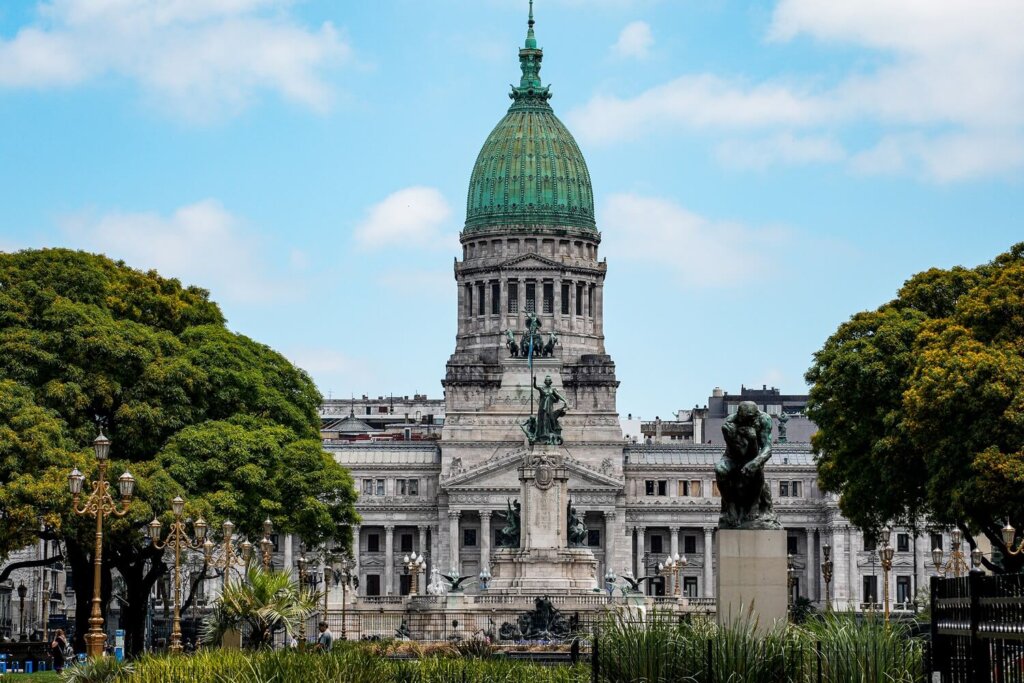
There was another iconic landmark at Plaza del Congreso that we wanted to see. The National Congress of Argentina, or Congreso de la Nación Argentina, is the seat of the Legislative Branch. It is where the two chambers of Congress, the Senate and the Chamber of Deputies, meet.
Construction on the building began in 1897, based on designs by architect Vittorio Meano. He designed it in a Greek and Roman architectural style. In 1904, the construction carried on under the supervision of architect Julio Dormal before it was inaugurated in 1906. However, the Congress building wasn’t actually fully completed until 1946. Since 1993, it has been a National Historic and Artistic Monument.
It is a very impressive building from the outside, with its green dome and imposing façade. You can also take a free tour inside between Monday and Friday if you reserve it in advance. Don’t forget to bring an ID card or passport on the day of your visit.
The Obelisk (El Obelisco)
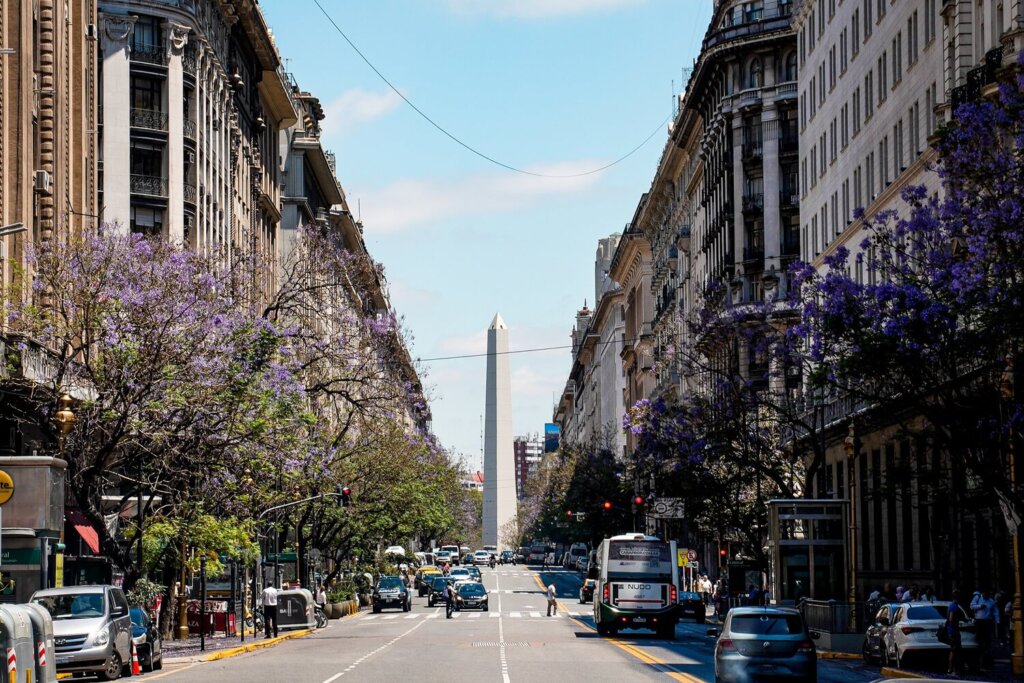
Just north of Plaza del Congreso and Avenida de Mayo, we ventured into the San Nicolas neighbourhood of Buenos Aires. There are many important landmarks in this barrio too, such as the city’s most recognisable one: the Obelisk (El Obelisco).
This 67-metre tall Obelisk is located at the junction of Avenida 9 de Julio and Avenida Corrientes. It was built in 1936 to commemorate the 400th anniversary of the city’s founding. In addition, it’s also the spot where they raised the Argentine flag for the very first time. An interesting fact that we read was that this symbol of the city wasn’t always welcomed by residents. There was a Spanish church at the site of the Obelisk, which had a historical significance for many. However, the mayor at the time wanted to modernise the city and also cut some of the ties to Argentina’s Spanish heritage.
The Obelisk was built in about a month, but three years later there was a vote amongst councillors to demolish it due to safety concerns. However, by this time the monument had actually become a symbol of the city, so in the end they vetoed the initial decision.
Teatro Colón & Plaza Lavalle
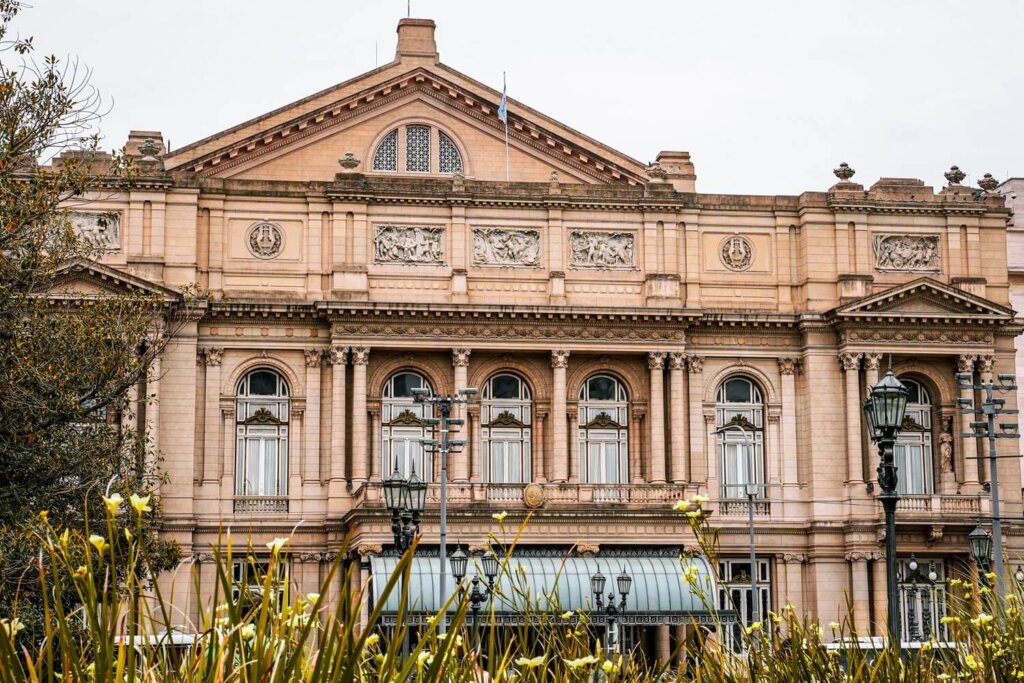
Further north of the Obelisk is Teatro Colon, which is often considered one of the best opera houses in the world. In an article by National Geographic, Colon Theatre was mentioned amongst other well-known opera houses around the world, such as the Sydney Opera House and the Paris Opéra.
Construction took 20 years and went through three different architects (Francesco Tamburini, Victor Meano and Jules Dormal) before it finally opened in 1908. It has a blend of Renaissance and Baroque styles. Over the decades, Colon theatre has hosted many famous performers. There are two ways you can experience Colon Theatre. You can either book a guided tour of the building or go and watch a play there.
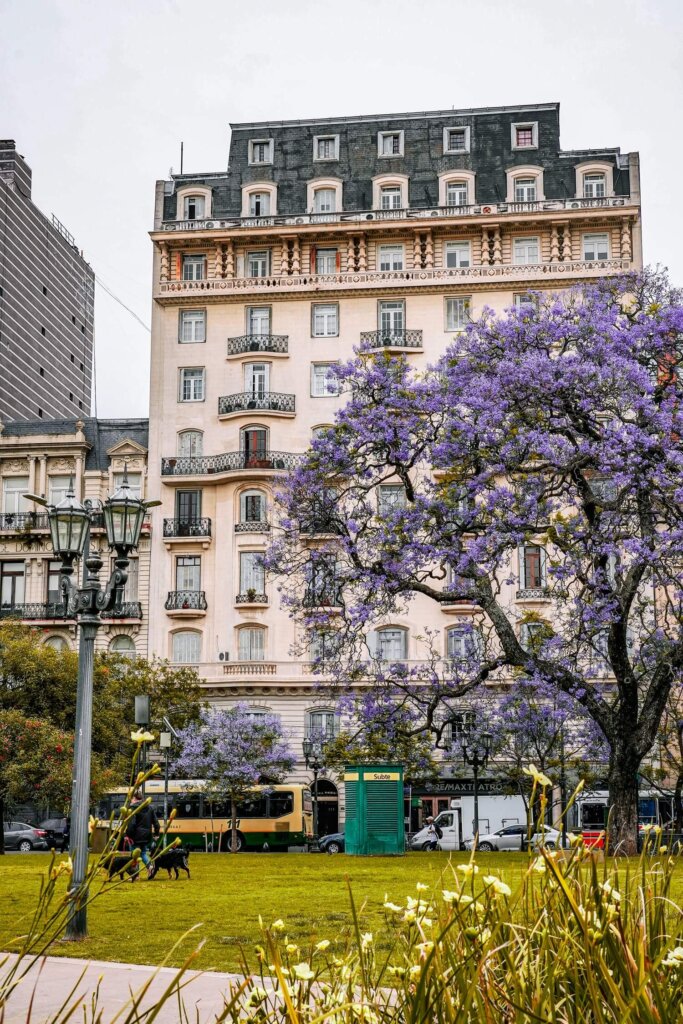
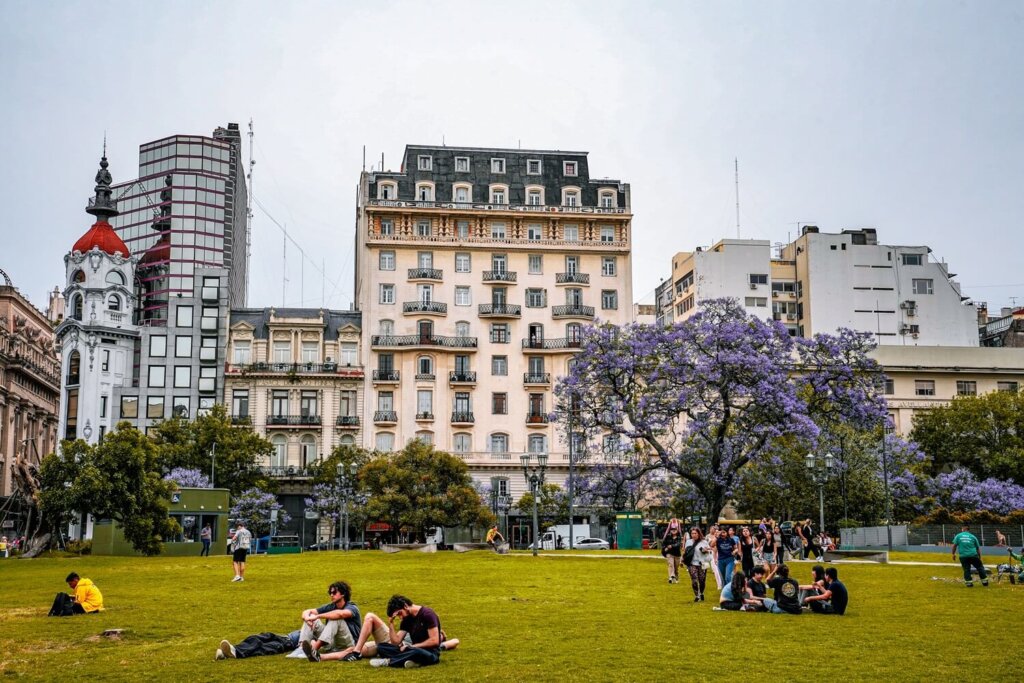
In front of the opera house, there’s a beautiful green park called Plaza Lavalle. We saw plenty of people sitting on the grass having their lunch in the park. It’s surrounded by other beautiful buildings and was really colorful in November, when the purple Jacaranda trees were blooming.

Florida Street (Calle Florida)
Lastly, we also took a walk down Florida street, one of the most well-known pedestrianised streets in the capital. Calle Florida is one of the oldest streets in Buenos Aires. Before they put cobblestones down along it in 1789, it used to just be a simple footpath. It was also the first street to be paved in the city. Its current name was given in 1821 to commemorate the Battle of Florida. From 1870, it became a commercial hub, when the city’s elite moved up to the northern barrios. There was even a tram running along it at one point, before it became fully pedestrianised in 1971. The street faced a period of decline as a shopping area, but today is once again a favoured commercial street.
We found a variety of shops lining both sides of the street, with endless numbers of vendors selling just about anything and plenty of street artists performing. Whilst for residents it’s mainly a shopping street, for foreign visitors it’s also a well-known street for exchanging their currency to Argentine pesos, because you can get a better exchange rate here than in a bank. We saw many people wearing a bum bag yelling ‘cambio’ , or even approaching us asking if we wanted to exchange our currency.
Where to Stay in Downtown Buenos Aires
Staying in downtown Buenos Aires is essentially basing yourself in the centre of all you can do in the capital. From downtown, you can easily reach the popular northern barrios, such as Recoleta and Palermo. You’re also going to be very close to barrios San Telmo and La Boca, one of the most colourful neighbourhoods in Buenos Aires. Below we’ve listed a few hotel and hostel options for downtown Buenos Aires:
- Franca City Hostel is perfect if you’re on a lower budget and want to socialise with fellow backpackers. It’s also right next to Palacio Barolo along Avenida de Mayo, so you’ll be close to many of the main attractions in downtown BA.
- Tango de Mayo Hotel is also located next to Palacio Barolo along Avenida de Mayo. The hotel is set in a refurbished historical building from the 1910’s, and breakfast is included in your stay.
- Studio Congreso is perfect for a slightly longer stay in the city. It’s also located next to Palacio Barolo, but is an entire studio apartment with a small kitchen and high speed internet.
- NH Collection Buenos Aires Centro Histórico is for those who don’t mind splashing the cash. The hotel sits next to Plaza de Mayo and has an outdoor pool with a sun terrace.
Other Neighbourhoods to Visit in Buenos Aires
Recoleta is without doubt one of the most elegant neighbourhoods in Buenos Aires. There are many trendy cafes, parks, museums and art galleries to visit in Recoleta. Not to mention the architecture, which’ll make you feel like you’re walking along the streets of Paris. Read our detailed guide on how to spend a day in Recoleta.
Palermo is the largest barrio in Buenos Aires. It has some of the best public parks and museums, as well as trendy sub-neighbourhoods with bars, cafes and plenty of street art. Read our detailed guide on how to spend a day in Palermo.
San Telmo is full of antique shops and historical buildings. It’s a great barrio to spend a few hours in, browsing for souvenirs or watching the tango performed in Plaza Dorrego. Read our detailed guide on visiting San Telmo.
La Boca is one of the most colourful barrios in Buenos Aires. You can stroll down Caminito, admire the murals and street art and also visit “La Bombonera” (Boca Juniors Stadium). Read our detailed guide on visiting La Boca.
Read Next: How to Spend 3 Days in Buenos Aires

Final Thoughts on the Monserrat and San Nicolas Neighbourhoods of Buenos Aires
There’s plenty to do in the Monserrat and San Nicolas barrios of Buenos Aires. In fact, we definitely felt a bit rushed trying to cram everything into one day and think it would’ve been better if we’d tried to do the two neighbourhoods over two days. Another thing we noticed was that a lot of places were closed on a Tuesday as well as a Monday. During our South America trip, we definitely knew to avoid visiting museums on Mondays, but here in BA, many are also shut on Tuesdays. Luckily, if you’re visiting on the right days, you can enjoy many of the main attractions free of charge. However, some entry fees, such as for Palacio Barolo, can be on the higher side.
Have you ever been to Buenos Aires before? Is so, did you manage to spend some time around the downtown area? If not, would you dedicate a day to this neighbourhood? Let us know in the comments below.
Now, let your adventure begin,

Remember…It all starts with a Pin…


Great advice on historical spots and where to eat.. I always try and eat locally when exploring a new city.
Thank you so much! There are so many great spots for food in BA.
This guide to Monserrat and San Nicolás is fantastic — I loved how you highlighted the historic landmarks around Plaza de Mayo and the guided tour of Colon theatre sounds interesting.
Thank you so much, I’m glad you enjoyed my guide.
Such an interesting article! I didn’t know much about Buenos Aires so thanks!
Thank you so much!
Great post! I’d love to visit Buenos Aries and this is a great guide to do it! Thanks!
Thank you! Hope you can get to BA in the near future.
Buenos Aires looks so charming from your photos! It seems to have such a unique vibe that’s half inviting half mysterious. I’ve never thought of visiting this city before but thanks to your post, it’s now on my travel list for next year!
Thank you for the lovely feedback. Yes, BA is such a great city to visit.