

How to Visit Tigre and the Parana Delta – A Day Trip from Buenos Aires

Buenos Aires is huge and you definitely won’t run out of things to do if you only have a few days in the city. However, there are many fantastic day trips from BA too if you’re in the capital for a bit longer, or just want to see something a little different. Whilst the most popular day trip is to Colonia del Sacramento in Uruguay, located only a short ferry ride from BA, there’s another fantastic place to visit close by: Tigre and the Parana Delta.
In this guide we’ll detail how easily you can visit the city of Tigre from Buenos Aires using public transport and how to explore the Parana Delta. As always, we’ve also included all the things to do so you can have a fun day away from the hustle and bustle of the capital.
If you’d like to see what we got up to in the Argentine capital, including our day trip to Tigre, then make sure to watch our dedicated Buenos Aires video, which we shared on our YouTube channel Kitti and Jon. For more videos from the country, check out our Argentina playlist.
Disclosure: This post may contain affiliate links, which means we may receive a small commission if you click a link and purchase something. Clicking these links won’t cost you anything, but it will help us to keep this site up and running! Learn more about our affiliate policy.
About Tigre and the Parana Delta in Buenos Aires
Tigre is a city in Buenos Aires Province located about 30 km northwest of Buenos Aires itself. The city lies on the Parana Delta, one of the largest river deltas in South America. The Parana River is actually the second longest river on the continent after the Amazon River. It runs through three countries: Paraguay, Argentina and Brazil. If you’re planning on visiting Iguazu Falls, then you can also see the confluence of the Parana River and the Iguazu River, as well as seeing the three aforementioned countries from the same spot. Now, what’s unique about the Parana River is that it’s the only river delta that empties out into another river: the Rio de la Plata.
Originally, this area was named by the Spanish, who called it “Las Conchas” (meaning “the shells”). However, in Argentine Spanish “concha” is used to refer to female parts, so in 1952 they officially renamed the city to Tigre. If you’re also wondering how on Earth they came up with the name “Tigre”, which means tiger in English, you’re not alone. Apparently, people encountered some jaguars here but they thought that they were tigers, hence the name Tigre.
Thanks to beautiful landscapes and the railway that arrived in 1865, Tigre became a popular tourist destination. People built beautiful villas and practiced different water sports, especially rowing. Today, many BA families still enjoy spending their weekend around Tigre and many tourists come here for a day trip to escape the busy capital.
Fun Fact. Tigre was actually one of the checkpoints in Season 2 of Celebrity Race Across the World, which took the teams from Brazil to the Chilean Lake District.

How to Visit Tigre and the Parana Delta from Buenos Aires
Getting to Tigre from Buenos Aires is very simple. The most cost effective way is by public transport, but you can also take a taxi or Cabify if you don’t mind paying extra. Alternatively, you can also join an organised tour.
Read Next: How to Spend 3 Days in Buenos Aires
Taking the Train to Tigre from Buenos Aires
Buenos Aires has a few suburban trains that connect the city with the suburbs. There are actually two train options when visiting Tigre: a direct train and a scenic coastal train. To be able to give you exact directions and compare both trains from personal experience, we took the direct train to Tigre and returned to Buenos Aires with the scenic train. View the suburban train map here.
Both trains depart from Retiro train station and are on the “Mitre” line. Use Google Maps to plan your route there from your accommodation.
Note. You’ll need a travel card, called SUBE, in order to use any mode of public transport in Buenos Aires. For further information, we recommend reading our complete Buenos Aires transportation guide.

Taking the Direct Train to Tigre
After arriving at Retiro train station, find the gates marked with Tigre above them. If you want to be on the direct train, you have to go through the gate that says “Tigre” which refers to the final station. Tapping the SUBE card grants you access to the platform. The direct train takes just under an hour and goes through the city. Get off at the last station which is called “Tigre”. Tap your SUBE card to exit the station. This is when you’ll see the final cost of your journey.
Overall, the direct train is fast, you don’t have to change trains and it’s cheaper than the scenic one.
Taking the Scenic Train to Tigre
The other train you can take to visit Tigre is the scenic train. Departing from Retiro train station, make sure to tap your SUBE card through the gate that says “Mitre” above it. Take the train to the last stop called Bartolome Mitre. Here, get off, tap your SUBE card and follow the directions towards Av. Maipu station. It’s a short walk and you really cannot get lost as most people will be heading to catch the connecting train too. Once at the station, tap your SUBE card again and board the train towards Delta station, which is where this train terminates.
This second train is essentially the scenic one, or the “tren de la costa”, which runs along the coast. If you want to get the absolute maximum out of your day, then we recommend taking the scenic train. You’ll have the chance to get on and off at any of the stations either on the way to Tigre Delta or on your return journey to BA. Probably the only downside of this option is that you have to change trains, the train journey is longer and the ticket will be more expensive. Plus, the first train will just travel through the city, so the whole ride is not “scenic” per se. Although we enjoyed the city views too.
Organised Day Trip to Tigre and the Parana Delta from Buenos Aires
Booking an organised day trip to Tigre and the Parana Delta is also a great option if you’re short on time, or don’t want to think too much about your transport to and from Tigre. Many of these tours also include a boat ride along the river, which is one of the best things to do in the Tigre Delta.

How to Spend a Day in Tigre and the Parana Delta – Best Things to Do
Take a Boat Ride Down the Parana Delta
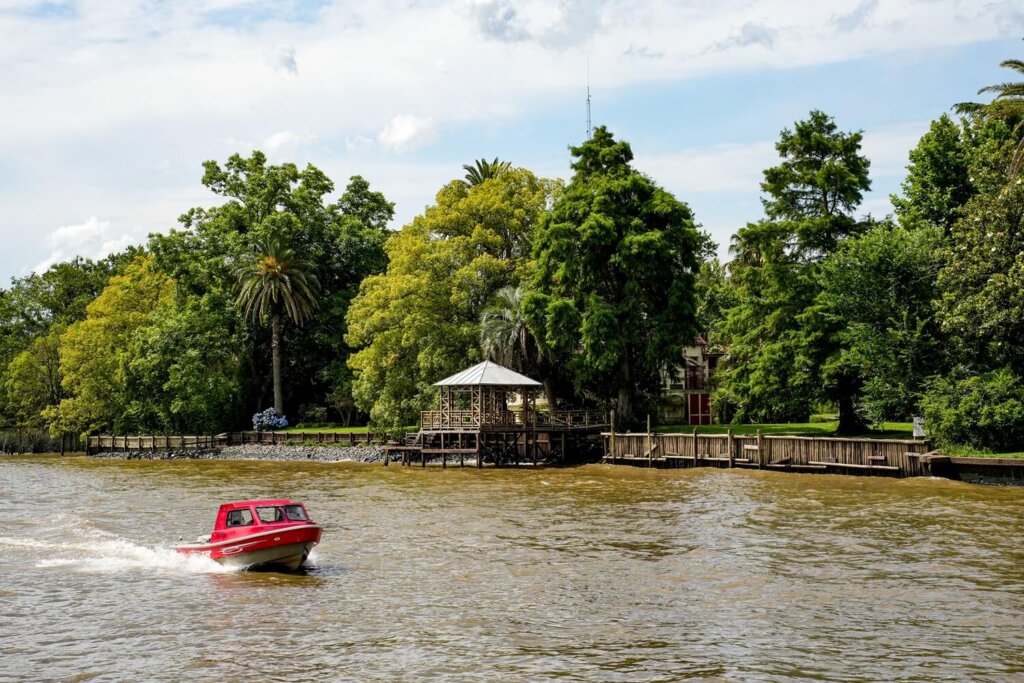
As mentioned above, the Parana Delta is one of the largest deltas in South America. This area is a maze of rivers, wetlands and tiny islands, making it one of the most biodiverse freshwater ecosystems on the continent. The area somewhat reminded us of the Xochimilco canals in Mexico City, just on a much larger scale.
The river delta is home to many long-term residents who live and work in this area. There are no roads, so residents rely on boats as their main mode of transport. However, many wealthier people also have holiday homes here.
The best way to get a glimpse of the life of the islanders is by taking a boat trip. You have the choice to use a public boat or water taxi to see some of the river delta, or to book on a private tour. Of course, the former option will be more affordable. Unless you’ve pre-booked a tour, Terminal Fluvial de Tigre is where you’ll want to go to check for boat tours and water taxis on the day of your visit.
Depending on what you want to get out of your river delta experience, going on a bigger or public boat will limit where you can go. Whereas embarking on a smaller one will give you access to areas a bigger boat can’t get to.


Stroll Down Paseo Victorica (Costanera de Tigre)
Paseo Victorica is essentially a walkway following the Lujan River. In Argentina, they refer to such waterfront promenades as a “costanera”. Paseo Victorica isn’t super long, but it is a mostly leafy walkway with many small plazas along it, and views of impressive rowing clubs and museums.
We suggest taking your time, enjoying the sunshine and stopping at many of the main landmarks along the way. You can visit the Argentine Naval Museum (Museo Naval de la Nación) if you want to learn about the country’s naval and maritime history. Another place we highly recommend stopping at is Heladeria via Toscana for a delicious ice cream. The interior of the building looked a little like the inside of a British pub. The promenade ends at the Museum of Art, one of the most impressive museum buildings we’ve ever seen.


Visit the Museum of Art (Museo de Arte de Tigre)
The Museum of Art definitely deserves its own section in this guide. Even if you’re not into art, the building the museum is housed in is absolutely worth walking all the way from the town centre for. Just like on numerous occasions in BA, we once again felt like we were in France, not Argentina. Plus, the entry fee is pretty affordable too if you do decide to visit the exhibition.
The building was built in 1912 in a Beaux-Arts style by French architects Pater & Dubois. It operated as a social club for the elite, called the Tigre Club, hosting meetings, parties and even a casino. In 1979 it was declared a National Historical Monument. After large scale remodelling work the museum opened to the public in 2006. Today, it displays the work of Argentine artists from the 19th and 20th centuries, including paintings and sculptures.
Opening times. From 1PM until 6PM on weekdays (Wednesday to Friday) and 12PM to 6PM on the weekends. It’s closed on Monday and Tuesday. For up-to-date admission fees, visit the official website.


Admire the Rowing Clubs
Something that we immediately noticed after arriving to Tigre was the large concentration of rowing clubs. Rowing was introduced by British immigrants towards the end of the 19th Century, as the Delta offered an ideal spot for the sport. Even the first official regatta in Argentina was held here in 1873. By the 20th Century, many other immigrant communities from Europe also adopted rowing and established clubs. The city of Tigre and its rowing clubs are actually on the UNESCO World Heritage Site tentative list.
As we walked around Tigre, we could see several well-preserved historic rowing clubs, some of which still operate as such today. One notable historical building is actually the Museum of Art, located at the end of Paseo Victorica.

Browse Puerto de Frutos Market
If you know a bit of Spanish, you may think that Puerto de Frutos is essentially a fruit market. The market was established in the 1930’s and served as an arrival point for boats loaded mainly with fruit, hence the name.
Today though, you won’t find many fruit shops. Instead, we found antiques, furniture and some food shops. This transformation happened in the 80’s and 90’s, when the Fruit Port lost its commercial importance and was transformed into a shopping hub.
The market is only a short walk from Delta Station, so you can either start or end your day here depending on which train you’re taking to and from the city. Many organised day tours also include a dedicated stop here or would give you enough free time for a quick wander around.

Enjoy Parque de la Costa – Tigre’s Amusement Park
One thing that immediately stood out to us in Tigre was the Amusement Park. We could see many rollercoasters and even a Ferris wheel from our walk along the costanera. Parque de la Costa was inaugurated in 1997 and has many adrenaline-pumping rides, including rollercoasters and water-rides. The rides are suitable for all ages, so if you’re a big fan of theme parks, definitely squeeze in a quick visit to Parque de la Costa.
For more up-to-date information, check out the park’s official website.

Final Thoughts on a Visit to Tigre and the Parana Delta from Buenos Aires
We’re so grateful that we could spend a few weeks in Buenos Aires, so we could easily find the time for a trip to Tigre. One day was perfect to walk around Tigre and enjoy the delta. After rushing around from one attraction to the next in the city, it was nice to just take things a little slower, go for a stroll, and enjoy the beautiful rowing clubs, the sunshine and a delicious ice cream.
Have you ever visited Tigre from Buenos Aires? If so, how did you get there and what was your favourite thing to do in Tigre? If not, would you add a day trip to Tigre to your Buenos Aires itinerary? Let us know in the comments below.
Now, let your adventure begin,

Remember…It all starts with a Pin…


I skipped Tigre during my Argentina road trip, but your post makes me wish I hadn’t — it looks like such a unique escape from the city. The mix of river life, the Parana Delta, and those waterfront walks sounds amazing. I really hope to go back one day and finally experience this day trip!
There’s so much to do in BA proper that I’m surprised that many people have to skip Tigre if they’re short on time. Hope you can return in the future, at least there will be something new to do in the city.
Love the architecture and I always love a promenade with waterfront views.
It was such a lovely area to wander around.
I haven’t been to South America, so places like this are new to me and are great to read about. I have heard lots of positive reviews about Argentina, and I think Tigre is a place I would like.
We absolutely loved Argentina! I think it is a great first country to visit in South America.
What a cool destination! Tigre looks amazing!
Thank you so much.
No matter what city I am in, my favorite thing to do is walk along a waterfront (as long as it has one). It’s just so peaceful and relaxing!
It’s always so nice to be close to nature even in a buzzing city like BA!
Tigre sounds like a wonderful day trip from Buenos Aires, especially for travelers looking for a peaceful escape into nature. The combination of scenic train rides, river cruises, and charming waterfront walks makes it very appealing.
I especially enjoyed the idea of exploring the Paraná Delta by boat and seeing how local island residents live without roads. This guide gives a great mix of practical tips and unique experiences for a day in Tigre.