
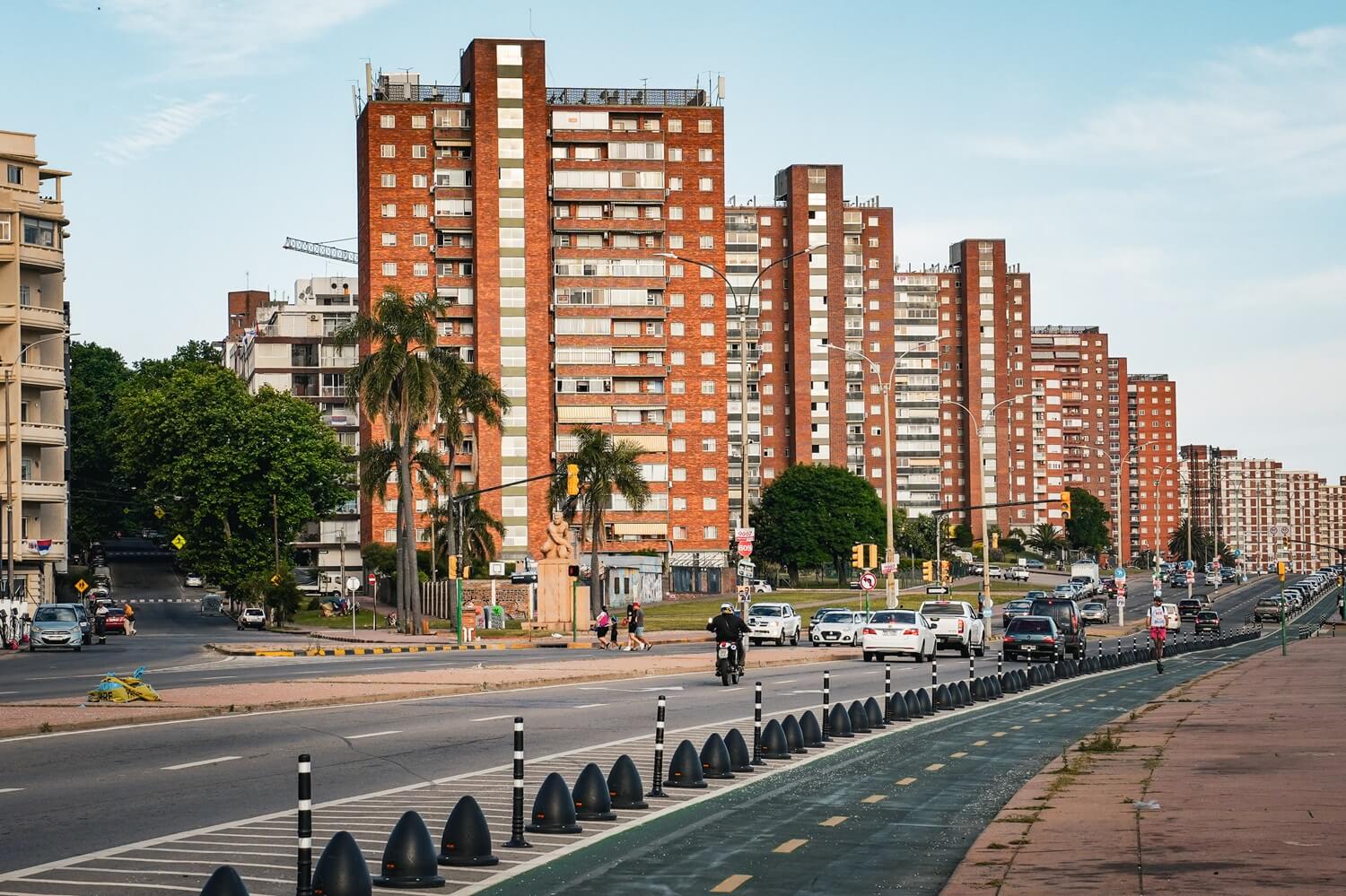
How to Get Around Montevideo in Uruguay

Visiting Montevideo, the Uruguayan capital, is most likely going to be on your itinerary if you’re wanting to spend some time in the country. We’ve put together a dedicated guide on some of the best things to do in Montevideo, which was one of the most laidback capitals we’ve ever visited. However, we also decided to write a separate transportation guide, which we personally always find useful to know about when visiting a new city. So, in this article we’ll detail everything we wish we’d known about getting around Montevideo in Uruguay. In addition, we’ll also run through all the ways you can reach the capital, including ground transportation options, ferries, and planes.
We spent about 4 days in Montevideo, and actually loved the city way more than we thought we would. If you’d like to see what we got up to in the country, you can watch our dedicated Uruguay video which we shared on our YouTube channel Kitti and Jon.
Disclosure: This post may contain affiliate links, which means we may receive a small commission if you click a link and purchase something. Clicking these links won’t cost you anything, but it will help us to keep this site up and running! Learn more about our affiliate policy.

How to Get to Montevideo in Uruguay
By Ferry from Buenos Aires, Argentina
Montevideo is located just across the Rio de la Plata from Buenos Aires, the capital of Argentina. Therefore, an easy way to get to Montevideo is with a ferry departing from the Argentine capital. The only company that provides direct ferries between the two cities is Buquebus. Buquebus Terminal is located in the Puerto Madero neighbourhood of Buenos Aires. Read our dedicated post if you want to learn more about how to get around Buenos Aires. There are two direct ferries per day and the journey time is 2.5 hours.
Purchase your ticket on Buquebus.
Alternatively, you can also get to Montevideo via a ferry and bus combo from Buenos Aires. Just book a ticket with either Colonia Express or Buquebus between BA and Montevideo. The ferry will only go as far as Colonia del Sacramento in Uruguay, a stunning colonial city. From Colonia, you’ll get transported to Montevideo by a bus provided by the ferry company. The total journey time will be around 4 hours, which includes the 1 hour 15 minute ferry ride between BA and Colonia.
To learn more about each ferry company, how the check-in and immigration process works and what the ferry ride is like, read our dedicated Argentina to Uruguay ferry guide.

By Bus from Colonia del Sacramento, Uruguay
We decided to visit Colonia del Sacramento first, then headed over to Montevideo after. To travel between the two cities we used a bus company called COT. We could buy tickets on COT’s website, but purchasing one at the bus station was also possible.
The bus to Montevideo departed from the Terminal de Omnibus in Colonia and dropped us off at the Tres Cruces Bus Terminal in Montevideo. You can either take a taxi or a local bus to the historic centre from there.
The journey took about 3 hours because the bus goes in and out of small towns along the way. There are about two “express” buses that only take 2 hours 20 minutes. The bus itself was comfortable enough for a short journey and had a toilet on board.
By Plane from Another Country
If you’re arriving from another country, you’ll most likely fly into Montevideo. There’s a direct flight to Montevideo from most capital cities in South America such as Bogota, Lima, Santiago, and many popular cities in Brazil, such as Rio de Janeiro. In addition, there’s also a direct flight from Madrid in Europe and Miami in Florida.
Montevideo International Airport (Aeropuerto Internacional de Carrasco) is also the main airport in Uruguay and is about 25 km from the city centre. To get to the centre, you can take a bus, a taxi, or a private transfer.

How to Get Around Montevideo in Uruguay
Top Tip. You should never travel without travel insurance. There are many different companies out there offering different levels of coverage depending on your needs. We personally use SafetyWing which offers coverage for digital nomads at an affordable price. You can also check out World Nomads which is good for backpackers or those on shorter trips.
Read Next: Best Things to Do in Montevideo
Public Buses in Montevideo
Montevideo has a fantastic bus system. We found it easy to use and could get everywhere we wanted to with a local bus. To plan our route and see which buses we would need to take, we just used Google Maps, which seemed to be pretty accurate. (Which is often not the case in South America, so it was a welcome change).
Note. You’ll have to wave the bus down if you want it to stop, otherwise it may drive past you!
We recommend buying an eSIM, so you have data that you can use to plan your travel route on the go. We use Holafly eSIM’s which offer unlimited data. This comes in useful for things such as following your location, or tracking your taxi or Uber ride. Get 5% off by using our code ‘KITTIAROUNDTHEWORLD’.


Bus Ticket Types and Cost in Montevideo
We could pay for a bus ticket either with cash or a travel card called an STM, which we’ll discuss more in the following section.
Top Tip. If you want to take money out of an ATM in Uruguay, try to use RedBROU bank as they seemed to have the lowest transaction fees. We always use our Wise card to withdraw money from an ATM and can also pay with it in most places that accept card payments. In addition, we could get some crisp $100 USD notes too, which we could then exchange to Argentine pesos in Argentina. We wrote a separate guide on navigating money in Argentina, so give it a read before your trip.
Común ticket. It’s a single ticket that allowed us to take one bus. Without the STM card, most single rides costed $56 UYU, whereas it was only $46 UYU with our STM travel card. However, there were a few more expensive buses where a común ticket cost $84 UYU without an STM card and $67 UYU with an STM.
1 hora ticket. When it looked like we needed to change buses, we got a 1 hour ticket. This allowed us to changes buses for free within an hour. It says on the ticket what time it expires, so there’s no need to memorise it. If you have an STM card, you still need to tap it when you change buses but it won’t charge you.


How to Get an STM Card in Montevideo
Since we stayed in Montevideo for 4 days and it looked like we would be using buses a lot, we decided to get a local STM card.
Even as a tourist we could get an STM card for free from an Abitab store. There are many Abitab shops across Montevideo. Just don’t forget to take your passport when you first get your card, and top it up with money before you use it. It’s worth noting that most of these Abitab shops are closed on Sundays.
Also, if there’s more of you using the same STM card on the bus, then tell the driver how many tickets you’ll need to buy with the same card, so he can adjust the number on the machine and you only have to tap once.
You can also keep track of your remaining balance on the bus ticket, which you’ll always get regardless of whether you pay with cash or an STM card.

Getting Around Montevideo on Foot
We love wandering around a new place on foot. Montevideo is a pretty walkable city once you get to your desired neighbourhood, or barrio. We highly recommend exploring the old town on foot, or walking along the beach or La Rambla. Our favourite activity during our stay was an evening stroll along the waterfront, which seemed to be residents’ favourite pastime too whilst sipping some mate.
However, Montevideo is still a sizeable city, so we suggest taking the bus between the main areas and then carrying on on foot once you’re there.


Using Taxis and Ubers in Montevideo
We used taxis a couple of times during our stay in Montevideo. It was mainly to get to and from the main bus terminal when we had all of our big bags. To our surprise we could pay by card for our taxi, so this might be a lifesaver if you don’t have local currency when you arrive. Plus, the driver had a printed list with the up-to-date charges. It generally felt safe to take a taxi. Obviously, taxis will be way more expensive than the public buses. However, we suggest taking one if you’re traveling during unsociable hours.
Whilst there is Uber in Montevideo, we didn’t see too many available drivers when we tried to use the app, so most of the time we just took taxis. But it’s also an option, so we thought it was worth mentioning.


Cycling in Montevideo
Lastly, a fun way to get around Montevideo is by bike. There are some bike lanes across the city, which makes it a safe and environmentally friendly method to travel between attractions located further apart.
Whilst we did walk along part of La Rambla, the 14-mile long coastal path is definitely much better traversed on two-wheels. Our accommodation had bikes we could’ve borrowed, so perhaps try to book a place that includes them or has a bike rental opportunity.
Alternatively, you can also join a biking tour. This 3-hour bike tour with a local guide will take you around the city to learn more about its history, culture and architecture. If you want to enjoy a fun but more effortless cycling experience, check out this 3-hour e-bike tour instead.
Final Thoughts on How to Get Around Montevideo
We really enjoyed getting around Montevideo by walking and using public buses. These two methods got us everywhere we wanted to go in the city. Of course, getting a taxi from the bus station to our accommodation initially was a great idea, so we didn’t have to figure out the bus system right after arriving with all of our big bags on us. Renting a bike would’ve also been fun for riding along La Rambla.
Have you ever been to Montevideo in Uruguay before? If so, how did you get around the city? If not, would you also use the public buses? Let us know in the comments below.
Now, let your adventure begin,

Remember…It all starts with a Pin…


I think bikes are a wonderful way to explore a city’s architecture! I did tours in Hungary and Slovenia. But you can also just rent a city bike.
Bike tours/rentals are so fun, especially because Montevideo has many bike lanes, so it felt like a safe city for cycling.
This is a city I would love to get back to. MANY years ago we had one day in Montevideo. Definitely not enough. It’s still on my radar. These are awesome tips and I will save this for later. Thank you!
I really hope that you can visit Montevideo again in the near future. We would return any time again for sure.
Would love to get here one day. This looks amazing. I love the architecture which you don’t see in the US.
I hope you can visit Uruguay in the near future. It’s such a beautiful city indeed.
What a useful guide! It’s great to see such clear info on how to get around Montevideo—from local transport to hidden gems off the beaten path. Thanks for sharing!
Thank you for the positive feedback on our guide.
What are the costs of the different transfer options from the airport into the city?
The local bus will be the cheapest which you can probably do under $4-5, but a taxi, or pick-up can cost anywhere between $40-50. Hope this helps.
Thanks for these great tips! Saving!
Thank you!
There are so many different ways to get to and around Montevideo! You’ve really managed to calm my nerves! Thank you!
Thank you , I’m glad to hear that you found this guide helpful.
Really helpful tips – transportation is always something we want to know about before heading to a new destination aaand Uruguay (especially Montevideo) is high on my list. Saving!
So happy that you found this transport guide helpful.
Thanks for sharing, there seems a lot to do in Montevideo and ways to get around, which is good idea for travelling on a budget 🙂
Thank you! It’s so easy to get around Montevideo.
Hello!
To see all schedules from all bus companies, you need to visit the URUBUS website: URUBUS.com.uy
.
There you can buy your tickets online easily, at the same price as at the terminal.